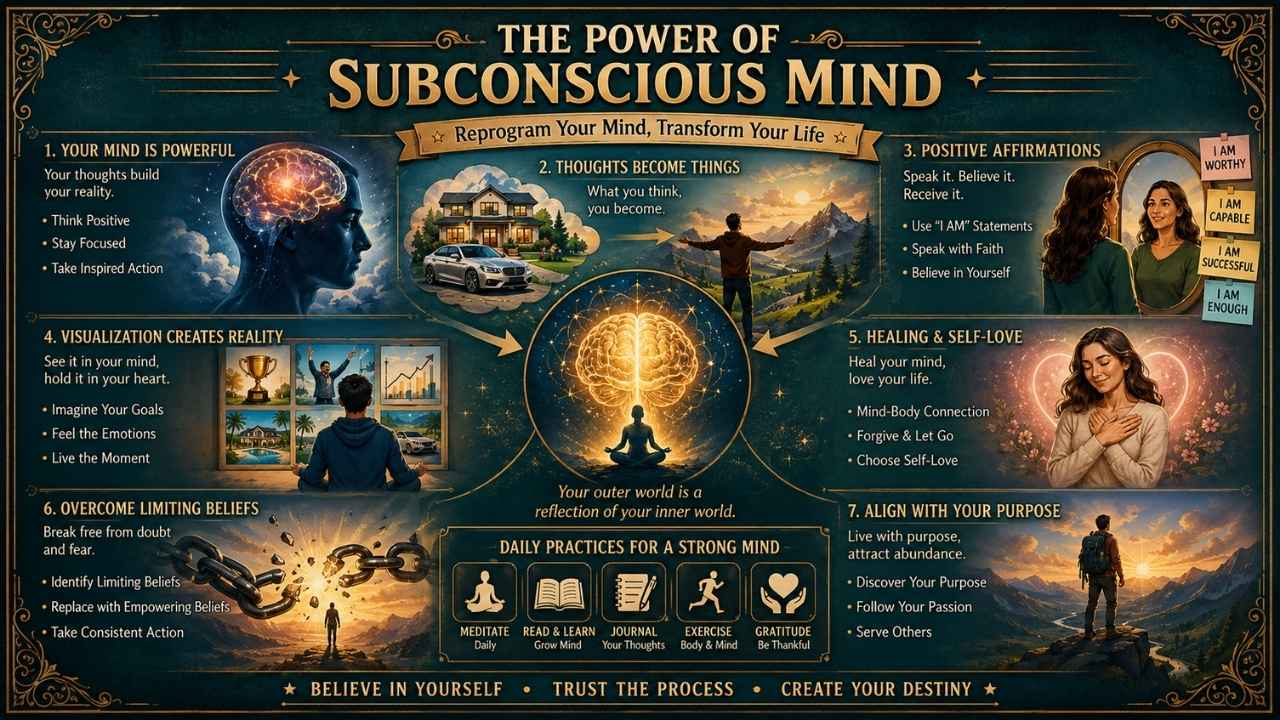
The Power of the Subconscious Mind: The human mind is one of the most fascinating and powerful forces in existence. Throughout history, philosophers, psychologists, spiritual teachers, and scientists have tried to understand how our thoughts influence our lives. Among the many books written on this subject, The Power of the Subconscious Mind remains one of the most influential and widely read works.
The book explores a simple yet profound idea: our subconscious mind plays a major role in shaping our beliefs, behaviors, decisions, emotions, and life experiences. While most people focus on conscious thinking, the subconscious quietly works in the background, influencing countless aspects of daily life.
Many readers are drawn to this book because it offers practical techniques for improving confidence, relationships, health, success, and overall happiness. Rather than presenting complicated theories, it encourages individuals to understand the connection between thought patterns and real world outcomes.
Whether you are new to personal development or have spent years studying the mind, the lessons contained in this book continue to resonate because they address a universal truth. The way we think often determines the way we live.
This article provides a comprehensive summary of the book, explores its most important lessons, and explains how its principles can be applied in everyday life.
Understanding the Conscious and Subconscious Mind
One of the central ideas presented in the book is the distinction between the conscious mind and the subconscious mind.
The conscious mind is the part of the mind that analyzes, reasons, evaluates, and makes decisions. It is responsible for logical thinking and active awareness.
The subconscious mind operates beneath conscious awareness. It stores memories, beliefs, emotions, habits, and automatic responses. Unlike the conscious mind, it does not evaluate information critically. Instead, it accepts repeated thoughts and beliefs as instructions.
A useful way to understand this relationship is to imagine a ship. The conscious mind acts as the captain giving directions, while the subconscious mind serves as the crew carrying out those commands. Whatever instructions are repeatedly given eventually become accepted as reality by the subconscious.
If a person constantly tells themselves they are incapable, unlucky, or destined to fail, those beliefs can become deeply rooted. On the other hand, positive and constructive thoughts can gradually create new patterns that support growth and achievement.
According to the book, understanding this relationship is the first step toward personal transformation.
The Subconscious Mind Never Stops Working
One of the most interesting concepts discussed in the book is that the subconscious mind is active twenty four hours a day.
Even while we sleep, subconscious processes continue. The body repairs itself, memories are organized, emotions are processed, and countless biological functions operate without conscious effort.
Most people do not need to think about breathing, digesting food, healing a wound, or regulating body temperature. These activities occur automatically through systems connected to subconscious processes.
The author argues that because the subconscious is always active, it continuously responds to dominant thoughts, emotions, and beliefs.
This idea highlights the importance of mental habits. A single negative thought may have little impact, but repeated negative thinking can gradually influence attitudes, behaviors, and outcomes. Similarly, positive mental conditioning can help create beneficial changes over time.
The subconscious mind functions much like fertile soil. Whatever seeds are planted repeatedly tend to grow.
The Role of Belief in Shaping Reality
A major lesson from the book is the extraordinary influence of belief.
Throughout history, belief has motivated people to achieve remarkable goals, overcome challenges, and persevere during difficult circumstances. The author suggests that belief acts as a bridge between thought and action.
When individuals genuinely believe they can succeed, they are more likely to take productive actions, remain persistent, and recognize opportunities.
Conversely, limiting beliefs often create invisible barriers.
Someone who believes they are incapable of learning new skills may avoid challenges altogether. Another person with confidence in their ability to improve is more likely to embrace growth and eventually achieve success.
The book repeatedly emphasizes that changing beliefs can change behavior, and changing behavior can change life outcomes.
This principle does not imply that positive thinking alone guarantees success. Instead, it highlights the role that mental attitudes play in influencing decisions and actions.
The Power of Repetition
One reason habits become deeply ingrained is repetition.
The subconscious mind learns through repeated exposure. Just as practicing a musical instrument strengthens skill over time, repeatedly thinking certain thoughts strengthens mental patterns.
Many people underestimate how often they repeat the same internal messages.
Some individuals constantly reinforce thoughts such as:
I am not good enough.
Nothing ever works out for me.
I always make mistakes.
I cannot succeed.
Over time, these statements can become accepted truths within the subconscious mind.
The book encourages replacing destructive mental habits with constructive ones.
Positive affirmations, encouraging self talk, and repeated visualization are presented as methods for creating healthier subconscious patterns.
The goal is not to ignore reality but to cultivate a mindset that supports growth rather than limitation.
Visualization as a Tool for Change
Visualization is one of the most widely discussed techniques in the book.
Visualization involves creating vivid mental images of desired outcomes.
Athletes often use visualization before competitions. Public speakers mentally rehearse successful presentations. Performers imagine confident performances before stepping onto a stage.
The author suggests that the subconscious mind responds strongly to emotionally charged mental images.
When individuals repeatedly imagine positive outcomes, they may become more confident, focused, and motivated.
For example, someone preparing for a job interview can visualize speaking clearly, answering questions effectively, and feeling calm throughout the process.
This mental rehearsal helps create familiarity and reduces anxiety.
Visualization works best when combined with action. Imagining success while taking no practical steps rarely produces meaningful results. However, visualization paired with preparation can become a powerful tool for personal development.
The Influence of Emotions
Thoughts become especially powerful when combined with emotions.
The book explains that emotions serve as amplifiers for mental messages.
A belief accompanied by strong emotion often leaves a deeper impression on the subconscious mind.
Fear, excitement, gratitude, anger, love, and hope all influence the way information is processed internally.
This is one reason emotionally significant experiences are remembered more vividly than ordinary events.
The author encourages cultivating positive emotional states because they reinforce constructive mental patterns.
Gratitude, in particular, is highlighted as a powerful emotional practice. Focusing on appreciation can shift attention away from scarcity and toward abundance.
While challenges and difficulties are unavoidable, maintaining emotional balance can improve resilience and overall wellbeing.
Overcoming Fear and Negative Thinking
Fear is one of the most common obstacles discussed in the book.
Fear can protect us from genuine danger, but it can also become excessive and limiting.
Many people avoid opportunities because of fear of failure, rejection, criticism, or uncertainty.
The book suggests that fear often grows stronger when it is repeatedly entertained in the imagination.
When individuals constantly imagine worst case scenarios, the subconscious mind may begin treating those possibilities as probable realities.
Breaking this cycle requires conscious effort.
The author recommends replacing fearful mental images with constructive alternatives.
Instead of focusing exclusively on what could go wrong, individuals can train themselves to consider what could go right.
This shift does not eliminate risk, but it helps prevent fear from becoming the dominant force in decision making.
The Connection Between Thoughts and Habits
Much of daily life is governed by habits.
From morning routines to communication styles, habits influence behavior more than many people realize.
The subconscious mind plays a central role in habit formation.
Once a behavior becomes habitual, it requires less conscious effort.
This principle can work for or against personal growth.
Helpful habits such as exercising, reading, saving money, and practicing gratitude can improve life over time.
Unhelpful habits such as procrastination, excessive worry, or negative self talk can create ongoing challenges.
The book encourages readers to focus on small, consistent improvements rather than dramatic overnight changes.
Repeated positive actions gradually reshape subconscious patterns and create lasting transformation.
The Importance of Self Image
One of the most influential ideas in personal development is that people often act in accordance with their self image.
If individuals see themselves as capable, resilient, and worthy of success, their actions tend to reflect those beliefs.
If they view themselves as inadequate or powerless, their behavior often aligns with that perception.
The subconscious mind works to maintain consistency between beliefs and actions.
Therefore, improving self image can have a profound impact on confidence and achievement.
The book encourages readers to develop a healthy and realistic sense of self worth.
This does not mean believing one is perfect. Rather, it means recognizing personal value while remaining open to growth and improvement.
Applying These Principles in Daily Life
The practical value of the book lies in its application.
Readers are encouraged to become more aware of their thoughts, beliefs, and emotional patterns.
Simple practices include:
Repeating constructive affirmations.
Visualizing desired outcomes.
Practicing gratitude daily.
Monitoring negative self talk.
Developing empowering beliefs.
Creating healthy habits.
Setting meaningful goals.
Maintaining a positive mental environment.
Over time, these practices can influence attitudes, behaviors, and decision making.
The cumulative effect of small changes often becomes significant.
Personal growth rarely occurs through a single breakthrough. More often, it results from consistent effort and gradual improvement.
Criticisms and Balanced Perspectives
While the book has inspired millions of readers, it is important to approach its ideas with balance.
Some claims about the subconscious mind are difficult to verify scientifically. Critics argue that certain concepts may oversimplify the relationship between thought and life outcomes.
Success depends on many factors, including education, opportunity, environment, skills, resources, timing, and effort.
Positive thinking alone cannot eliminate every obstacle.
However, even many critics acknowledge the practical value of developing constructive beliefs, healthy habits, emotional resilience, and a growth oriented mindset.
Viewed through this balanced lens, the book serves as a motivational guide rather than a guaranteed formula for success.
Conclusion
The enduring popularity of The Power of the Subconscious Mind reflects humanity’s deep interest in understanding the connection between thoughts and reality.
Its central message is simple yet powerful. The beliefs we repeatedly hold influence our attitudes, emotions, habits, and actions. By becoming aware of these patterns and intentionally cultivating healthier ones, we can create positive changes in many areas of life.
The book encourages readers to view the mind as a valuable resource rather than an uncontrollable force. Through awareness, repetition, visualization, and constructive thinking, individuals can gradually reshape limiting beliefs and unlock greater potential.
While no single book contains all the answers, the lessons presented here offer timeless reminders about the importance of mindset, self awareness, and personal responsibility.
Ultimately, the greatest power of the subconscious mind may not be its ability to change the world around us, but its ability to change the way we perceive, approach, and experience that world.