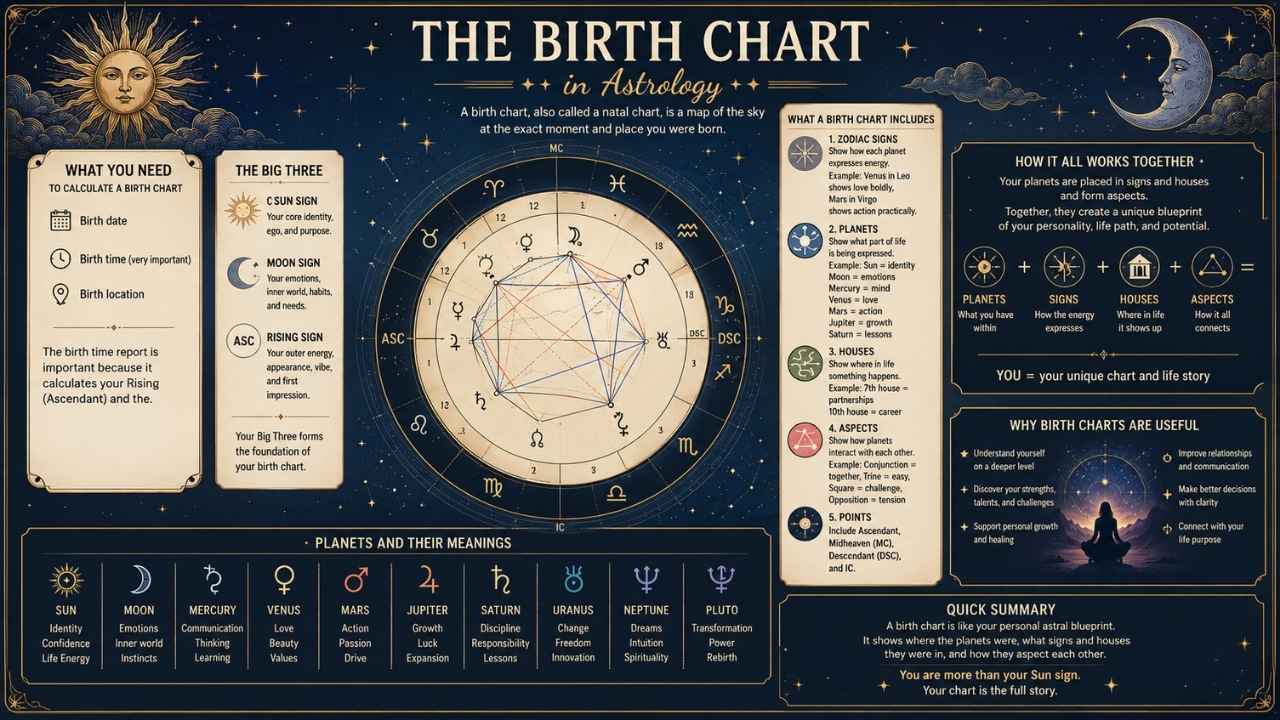
The Birth Chart Explained: Have you ever read your daily horoscope and wondered how a few lines of text could possibly describe your personality, emotions, relationships, and future? For many people, astrology begins with a simple curiosity about their zodiac sign. Yet as they explore further, they discover that astrology is much deeper than the twelve signs most people already know.
At the heart of astrology lies something called a birth chart. Often referred to as a natal chart, a birth chart is like a cosmic snapshot of the sky at the exact moment you were born. It maps the positions of the Sun, Moon, planets, and other celestial points from your unique perspective on Earth. Astrologers believe this chart reveals valuable insights into personality traits, emotional patterns, strengths, challenges, life lessons, and personal growth opportunities.
For beginners, a birth chart can look overwhelming. It contains symbols, circles, lines, planets, houses, and signs that seem impossible to understand at first glance. However, once you learn the basics, the chart begins to tell a fascinating story about who you are and how you interact with the world around you.
This guide will walk you through the essential elements of a birth chart in simple language. Whether you are completely new to astrology or looking to deepen your understanding, this article will help you decode the symbols and uncover the meaning behind your cosmic blueprint.
What Is a Birth Chart?
A birth chart is a map of the sky at the exact time, date, and location of your birth. Unlike a horoscope that focuses only on your Sun sign, a birth chart considers the positions of all major planets and astrological points.
Imagine taking a photograph of the heavens at the moment you entered the world. That photograph becomes your personal birth chart. Every person’s chart is unique because even a few minutes can change certain planetary positions and house placements.
Astrologers use three key pieces of information to create a birth chart:
Your date of birth
Your exact time of birth
Your place of birth
Without an accurate birth time, some important details may be missing or less precise. This is because the houses and rising sign change throughout the day.
A birth chart is often seen as a guide rather than a prediction tool. It does not determine your destiny. Instead, it highlights tendencies, strengths, challenges, and possibilities that can help you understand yourself better.
Why Birth Charts Matter
One reason astrology has remained popular for centuries is its ability to encourage self reflection. Many people turn to birth charts not because they want to know the future but because they want to understand themselves more deeply.
A birth chart can offer insights into:
Your natural talents
Your emotional needs
Your communication style
Your approach to relationships
Your career motivations
Your personal challenges
Your spiritual growth journey
Think of your birth chart as a mirror. It does not tell you who you must become. Instead, it reflects different aspects of your personality and potential.
People often find comfort in seeing certain patterns explained through astrology. For example, someone who struggles with expressing emotions may discover a strong influence from Saturn. Another person with a highly imaginative nature may find prominent Neptune placements.
The chart provides language for experiences many people already feel but cannot easily describe.
Understanding the Big Three
When beginners start learning astrology, they often hear about the Big Three. These are the Sun sign, Moon sign, and Rising sign.
Together, they form the foundation of your astrological identity.
The Sun Sign
The Sun represents your core identity. It reflects your sense of self, your ego, your purpose, and the qualities you naturally express.
Most people know their Sun sign because it is based on their birth date.
For example:
Aries is energetic and bold.
Taurus is stable and practical.
Gemini is curious and adaptable.
Cancer is nurturing and emotional.
Leo is confident and creative.
Virgo is analytical and detail oriented.
Libra is balanced and relationship focused.
Scorpio is intense and transformative.
Sagittarius is adventurous and optimistic.
Capricorn is disciplined and ambitious.
Aquarius is innovative and independent.
Pisces is compassionate and imaginative.
Your Sun sign describes the person you are becoming throughout life.
The Moon Sign
If the Sun represents your outer identity, the Moon represents your inner world.
Your Moon sign reveals:
Emotional reactions
Instinctive behaviors
Comfort zones
Deep needs
Private feelings
Many people feel a stronger connection to their Moon sign as they grow older because it reflects their emotional truth.
For example, a person with a Leo Sun may appear confident and outgoing, but if they have a Pisces Moon, they may also be highly sensitive and empathetic beneath the surface.
The Moon sign often explains why people with the same Sun sign can have completely different personalities.
The Rising Sign
The Rising sign, also known as the Ascendant, is one of the most important parts of the chart.
It represents:
First impressions
Physical appearance
Behavior in new situations
The way others perceive you
Your approach to life
Because the Earth rotates continuously, the Rising sign changes approximately every two hours. This is why an accurate birth time is so important.
Someone with a Cancer Rising may appear gentle and caring when meeting people for the first time. A Scorpio Rising individual may come across as mysterious and intense.
The Rising sign acts like the front door to your personality. It shapes how the rest of your chart is expressed.
The Planets and Their Meanings
In astrology, each planet symbolizes a different aspect of human experience.
The Sun represents identity and life purpose.
The Moon represents emotions and instincts.
Mercury governs communication and thinking.
Venus influences love, beauty, and relationships.
Mars represents action, desire, and motivation.
Jupiter symbolizes growth, luck, and expansion.
Saturn governs discipline, responsibility, and lessons.
Uranus represents innovation and change.
Neptune influences dreams, spirituality, and imagination.
Pluto symbolizes transformation and personal power.
Each planet occupies a zodiac sign and house in your birth chart, creating a unique combination of energies.
The Twelve Astrological Houses
While planets describe what energy is present and signs explain how that energy behaves, houses reveal where the energy is expressed.
The First House relates to identity and self image.
The Second House relates to money and personal values.
The Third House governs communication and learning.
The Fourth House relates to home and family.
The Fifth House governs creativity and romance.
The Sixth House relates to work and health.
The Seventh House governs partnerships and marriage.
The Eighth House relates to transformation and shared resources.
The Ninth House governs travel and higher learning.
The Tenth House relates to career and reputation.
The Eleventh House governs friendships and community.
The Twelfth House relates to spirituality and the subconscious mind.
The placement of planets within these houses helps astrologers understand which life areas receive the strongest focus.
How the Zodiac Signs Influence the Planets
A planet expresses itself differently depending on the sign it occupies.
For example, Mercury in Gemini tends to communicate quickly and intelligently. Mercury in Taurus may communicate more slowly but with greater practicality.
Similarly, Venus in Libra often seeks harmony and balance in relationships, while Venus in Scorpio may desire emotional depth and intense connections.
This combination of planets, signs, and houses creates the complexity that makes every birth chart unique.
The Role of Aspects
Aspects are the angles formed between planets in a birth chart.
These angles show how different energies interact with one another.
Some aspects create harmony and flow, while others create tension and growth opportunities.
The most common aspects include:
Conjunctions
Sextiles
Squares
Trines
Oppositions
A square between Mars and Saturn may indicate challenges with frustration or patience. A trine between Venus and Jupiter may suggest natural charm and optimism.
Aspects add depth and complexity to chart interpretation and often reveal important themes throughout a person’s life.
Birth Charts as Tools for Self Discovery
One of the greatest strengths of astrology is its ability to encourage self awareness.
A birth chart can help you recognize recurring patterns, understand emotional triggers, and appreciate your natural strengths. Instead of viewing challenges as flaws, astrology invites you to see them as opportunities for growth.
Many people discover that their chart validates experiences they have felt for years. It can provide clarity, confidence, and a deeper sense of personal understanding.
Rather than limiting you, a birth chart can empower you to make more conscious choices and navigate life with greater awareness.
Conclusion
A birth chart is much more than a collection of symbols and planetary positions. It is a detailed map of your unique personality, emotional landscape, strengths, challenges, and potential.
By understanding the Sun, Moon, Rising sign, planets, houses, and aspects, you begin to uncover the deeper story written within your chart. Astrology does not claim to control your destiny, but it can offer valuable insights into who you are and how you relate to the world around you.
For beginners, learning astrology may seem complicated at first, but every chart starts making sense one piece at a time. As you continue exploring, you may discover that your birth chart serves as a powerful tool for self discovery, reflection, and personal growth.
The stars may not dictate your future, but they can help illuminate the path toward understanding yourself more deeply.