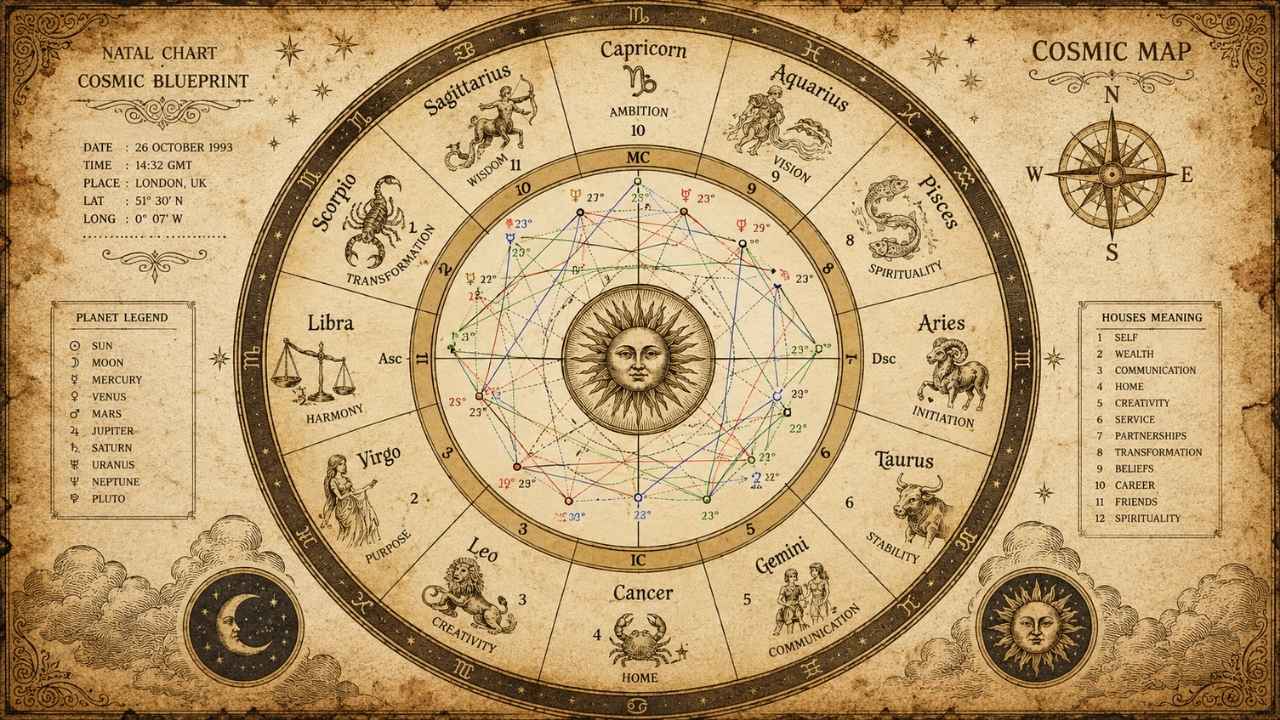
Astrology Birth Chart Reading for Beginners: Have you ever wondered why certain personality traits seem deeply rooted within you, no matter how much you change over time? Why do some people naturally gravitate toward leadership while others excel in creativity, communication, or nurturing relationships? Astrology offers one fascinating way to explore these questions through a birth chart.
A birth chart, often called a natal chart, is like a cosmic snapshot of the sky at the exact moment you were born. It maps the positions of the Sun, Moon, planets, and other celestial points, creating a unique blueprint that many believe reflects personality patterns, strengths, challenges, and life themes.

For beginners, a birth chart can appear overwhelming. The circular diagram, filled with symbols, lines, and divisions, may seem impossible to understand at first glance. However, once you learn the basic building blocks, the chart becomes a powerful tool for self exploration and personal growth.
This guide will walk you through the essential elements of birth chart reading in a simple and approachable way. Whether you are completely new to astrology or curious about understanding yourself on a deeper level, this beginner friendly introduction will help you unlock the insights hidden within your cosmic blueprint.

What Is a Birth Chart?
A birth chart is a map of the heavens at the exact date, time, and location of your birth. Astrologers use this information to calculate where each planet was positioned in the zodiac at that moment.
Unlike daily horoscopes that focus mainly on your Sun sign, a birth chart reveals a much more detailed picture. Every planet occupies a specific zodiac sign and house, creating a unique combination that influences different areas of life.
Think of your birth chart as a personalized guidebook. While it does not dictate your future, many people use it as a framework for understanding their motivations, emotional patterns, relationships, talents, and life lessons.
Each chart is unique because even a small difference in birth time can alter certain placements. This individuality is one reason birth chart readings are often considered more insightful than general horoscope predictions.

Why Birth Charts Fascinate So Many People
People are naturally curious about themselves. We want to understand our strengths, weaknesses, desires, and purpose. Birth charts provide a symbolic language that encourages self reflection.
Many individuals discover aspects of their personality that they had never consciously recognized. Others find comfort in seeing their struggles represented within a larger cosmic framework.

A birth chart can also encourage personal development. By understanding recurring patterns, people may become more aware of habits that support or hinder their growth.
Rather than offering rigid answers, astrology often presents opportunities for reflection. The chart becomes a mirror that invites deeper awareness and thoughtful exploration.

Understanding the Three Big Elements
When beginners first start studying astrology, they often hear about the Sun sign, Moon sign, and Rising sign. These three components form the foundation of birth chart interpretation.
The Sun sign represents your core identity. It reflects the qualities that define your sense of self and personal purpose. This is the sign most people know because it forms the basis of popular horoscopes.

The Moon sign reveals your emotional world. It shows how you process feelings, seek comfort, and respond to emotional experiences. Many astrologers consider the Moon sign just as important as the Sun sign.
The Rising sign, also called the Ascendant, represents the way you present yourself to the world. It influences first impressions, personal style, and how others perceive you.

Together, these three placements create a more complete portrait of who you are.
The Twelve Zodiac Signs
The zodiac consists of twelve signs, each associated with specific characteristics and energies. Understanding these signs is essential for interpreting a birth chart.

Aries is known for courage, initiative, and enthusiasm. People with strong Aries energy often enjoy taking action and embracing new challenges.
Taurus values stability, comfort, and persistence. This sign is associated with patience, practicality, and appreciation for life’s pleasures.
Gemini represents curiosity, communication, and adaptability. Individuals influenced by Gemini often enjoy learning and exchanging ideas.
Cancer is connected to emotions, family, and nurturing. This sign values security and meaningful emotional connections.
Leo embodies confidence, creativity, and self expression. Many Leos enjoy inspiring others and sharing their talents.
Virgo focuses on organization, improvement, and attention to detail. Practicality and service are common themes.
Libra seeks harmony, balance, and partnership. Relationships and fairness often play significant roles.
Scorpio is associated with transformation, intensity, and emotional depth. This sign values authenticity and meaningful experiences.
Sagittarius represents adventure, exploration, and wisdom. A love for learning and freedom frequently appears here.
Capricorn emphasizes discipline, ambition, and responsibility. Long term goals and achievement are important themes.
Aquarius values innovation, individuality, and progress. Independent thinking often characterizes this sign.
Pisces is linked to compassion, imagination, and spirituality. Sensitivity and creativity are common qualities.
The Planets and Their Meanings
In astrology, planets symbolize different aspects of human experience.
The Sun represents identity and vitality.
The Moon reflects emotions and instincts.
Mercury governs communication and thinking.
Venus influences love, beauty, and relationships.
Mars symbolizes action, motivation, and desire.
Jupiter is associated with growth, optimism, and expansion.
Saturn represents structure, discipline, and responsibility.
Uranus relates to innovation, change, and independence.
Neptune governs dreams, intuition, and imagination.
Pluto symbolizes transformation, power, and renewal.
The meaning of each planet changes depending on the sign and house where it is located.
What Are Houses in Astrology?
The birth chart is divided into twelve sections called houses. Each house governs a specific area of life.
The first house relates to identity and appearance.
The second house concerns money, values, and resources.
The third house focuses on communication and learning.
The fourth house represents home and family.
The fifth house governs creativity, romance, and self expression.
The sixth house relates to work, health, and daily routines.
The seventh house focuses on partnerships and relationships.
The eighth house deals with transformation and shared resources.
The ninth house governs travel, higher education, and philosophy.
The tenth house represents career and public reputation.
The eleventh house focuses on friendships and community.
The twelfth house relates to spirituality, reflection, and the subconscious mind.
Understanding the houses helps you identify where specific planetary energies are most active in your life.
How to Start Reading Your Own Birth Chart
The best approach is to begin slowly. Focus first on your Sun, Moon, and Rising signs. Learn what each placement represents and how they interact.
Next, examine where your planets are located. Notice which houses contain multiple planets, as these areas often receive greater emphasis.
Pay attention to recurring themes. For example, if several planets appear in communication related signs or houses, communication may be an important life focus.
Avoid trying to understand everything at once. Birth chart interpretation is a gradual process that becomes richer over time.
Birth Charts as a Tool for Self Discovery
One of the greatest benefits of astrology is its ability to encourage self awareness. A birth chart can highlight strengths you may not fully appreciate and reveal challenges that deserve attention.
Many people use astrology for personal reflection, journaling, goal setting, and understanding relationship dynamics. The chart becomes a guide that supports conscious growth and self understanding.
Rather than predicting a fixed destiny, birth chart reading can inspire thoughtful questions about who you are and who you are becoming.
Conclusion
Astrology birth chart reading offers a fascinating journey into self discovery. While the symbols and terminology may seem complex at first, the fundamentals are surprisingly approachable when broken into simple steps.
By learning about zodiac signs, planets, houses, and key placements, you can begin uncovering the unique patterns that make your chart different from everyone else’s. Whether you view astrology as a spiritual practice, a psychological tool, or simply an interesting perspective on life, exploring your birth chart can lead to valuable insights and a deeper understanding of yourself.
The stars may not define every aspect of your life, but they can provide a meaningful framework for reflection, growth, and personal exploration. As you continue learning, your birth chart can become a lifelong companion on the journey toward greater self awareness and understanding.